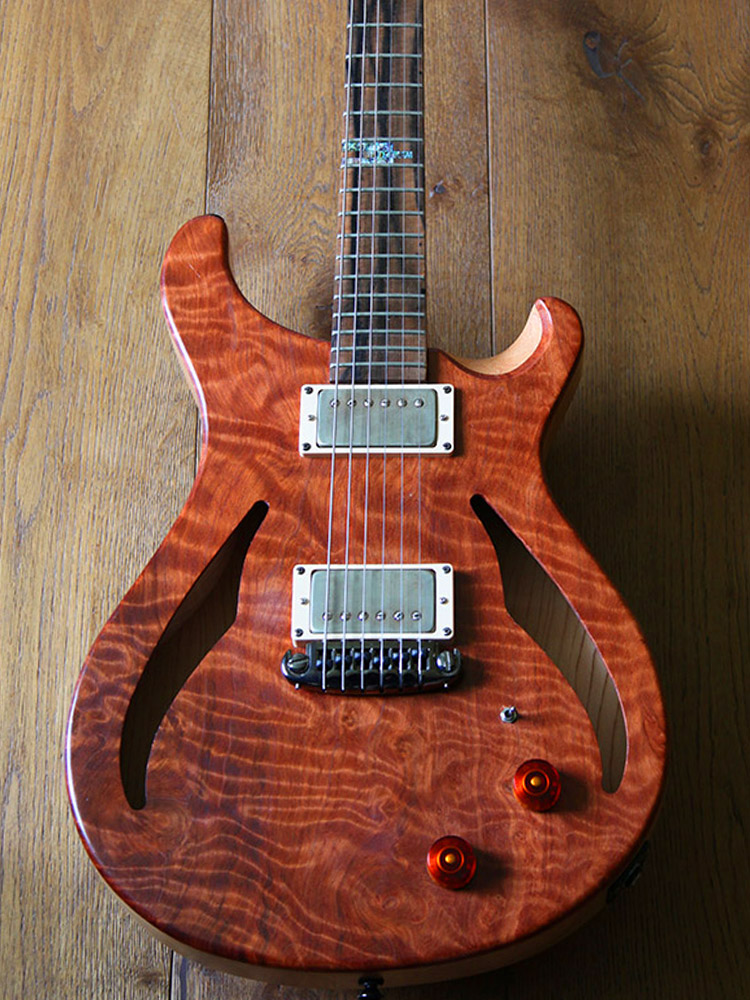
This is the first time I've made a series of related guitars and they are the first guitars I am offering for sale. Each guitar is made from pieces of wood that have a known history. It is about the idea of combining sustainability (which becomes possible when you know exactly where the wood came from) and the history of a special piece of wood. The guitars aren't identical in construction as each is a one off piece of design, but the overall shape and idea is the same.
A couple of terms may need explaining here. ‘Storm felled’ or ‘Lightning felled’ describes a tree which would have not normally be felled, but has been either knocked down or irreparably damaged by storm. Sometimes these are offered to a mill by the land-owner, sometimes they are discovered in the wild.
Forgotten and reclaimed are adjectives used in conjunction with woods that are no longer logged due to CITES restrictions. CITES is very effective in protecting endangered woods; it is not a ban on logging, which is hard to control in many countries where such woods exist, but a rigorous ban on all international trade. In short it works very well in protecting endangered woods, using the much more effective authority of international customs inspection to make trade impractical. I'm pleased to say that guitar makers don’t see newly felled CITES endangered wood being offered to them.
But with almost all of these woods there are small residual stocks dating from before restrictions began. True Brazilian and Honduran Mahogany: Swietenia macrophylla, benefitted from the fact that Mahogany has been very unfashionable for furniture and housebuilding for a long time. So traditional woodyards have sometimes had a pile of very old boards languishing in a corner for decades. Luthiery suppliers seek out these ‘forgotten' stocks, some of them up to a hundred years old. Also Victorian houses and furniture are often made from this wood, but again, there is little market appeal. So a dining table or a staircase may be pulled out and the wood, benefitting from a century or so of ageing, can be reclaimed and re-used. I have small stocks of both of these sources of wood. It’s not cheap, but it feels really special to work on: and it produces special instruments.
Lastly we have the wonderful story of Crelicam Ebony. This project in the Cameroon is a joint venture of Taylor Guitars and Madinter; a Luthiery supply company. They are recovering old discarded logs of ebony with the help of local indigenous people. They pay the tribespeople well for their finds, but require them to assist in planting a hundred new ebony trees for every abandoned log they bring in to the mill. Google It.
A couple of terms may need explaining here. ‘Storm felled’ or ‘Lightning felled’ describes a tree which would have not normally be felled, but has been either knocked down or irreparably damaged by storm. Sometimes these are offered to a mill by the land-owner, sometimes they are discovered in the wild.
Forgotten and reclaimed are adjectives used in conjunction with woods that are no longer logged due to CITES restrictions. CITES is very effective in protecting endangered woods; it is not a ban on logging, which is hard to control in many countries where such woods exist, but a rigorous ban on all international trade. In short it works very well in protecting endangered woods, using the much more effective authority of international customs inspection to make trade impractical. I'm pleased to say that guitar makers don’t see newly felled CITES endangered wood being offered to them.
But with almost all of these woods there are small residual stocks dating from before restrictions began. True Brazilian and Honduran Mahogany: Swietenia macrophylla, benefitted from the fact that Mahogany has been very unfashionable for furniture and housebuilding for a long time. So traditional woodyards have sometimes had a pile of very old boards languishing in a corner for decades. Luthiery suppliers seek out these ‘forgotten' stocks, some of them up to a hundred years old. Also Victorian houses and furniture are often made from this wood, but again, there is little market appeal. So a dining table or a staircase may be pulled out and the wood, benefitting from a century or so of ageing, can be reclaimed and re-used. I have small stocks of both of these sources of wood. It’s not cheap, but it feels really special to work on: and it produces special instruments.
Lastly we have the wonderful story of Crelicam Ebony. This project in the Cameroon is a joint venture of Taylor Guitars and Madinter; a Luthiery supply company. They are recovering old discarded logs of ebony with the help of local indigenous people. They pay the tribespeople well for their finds, but require them to assist in planting a hundred new ebony trees for every abandoned log they bring in to the mill. Google It.