The rebuilding of ‘waterfall’
22nd Sept
Waterfall was the name given to my first semi acoustic build, serial number 103, so my third guitar. It was one of two spectacular pieces of waterfall Bubinga I selected on a visit to Timberline in Tunbridge Wells. It is a rare pattern that combines ripple and cushion patterning with both the red heartwood and white sapwood. When bookmatched with the sapwood in the centre, it creates a wonderful waterfall effect. I’d made it as a Jazz guitar, but the Maple neck and fretboard, while really pretty, wasn’t my favourite. It also had a Graphtech Ghost 6 pickup piezo system in it which was really interesting. I had omitted F holes as I knew the interior would have a lot of wiring that needed tucking away. It ought to be a good instrument, but I wasn’t picking it up and playing it.
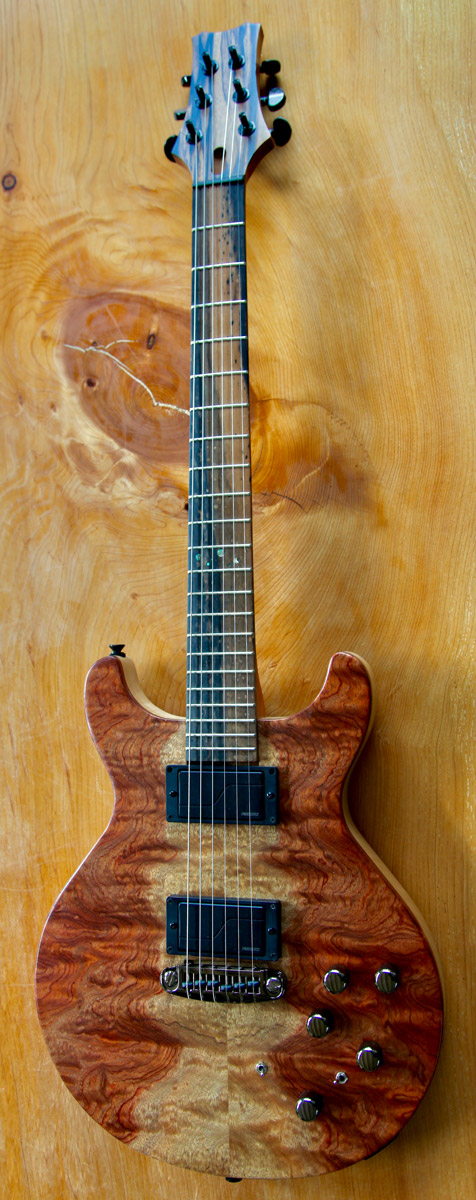

A few weeks ago, I decided that such an amazing piece of wood couldn’t be left in the rack, so I thought about how I could give it a makeover. The blunt truth was I wasn’t going to really love it with that neck, so that would mean doing my most hated job: removing a glued-in neck.
The theory is you inject heat or steam into it until the glue can be forced to give up, but that can easily trash the top. But, as I didn’t want to keep the neck anyway, I resolved to try a less traumatic solution. I would remove the frets that were above the neck body join, then I could carefully drill out the neck wood right through to the pocket, just leaving a few remnants round the side and bottom. First I’d have to cut around the neck at about the 18th fret very carefully so I could take the bulk of the neck off and pull the trussrod out, as I couldn’t drill through the steel of the trussrod. It all felt brutal to do, but unlike playing with steam, didn’t endanger the body at all. Once that was done, I could re-rout the pocket join to clean it all up and I had a neckless body.
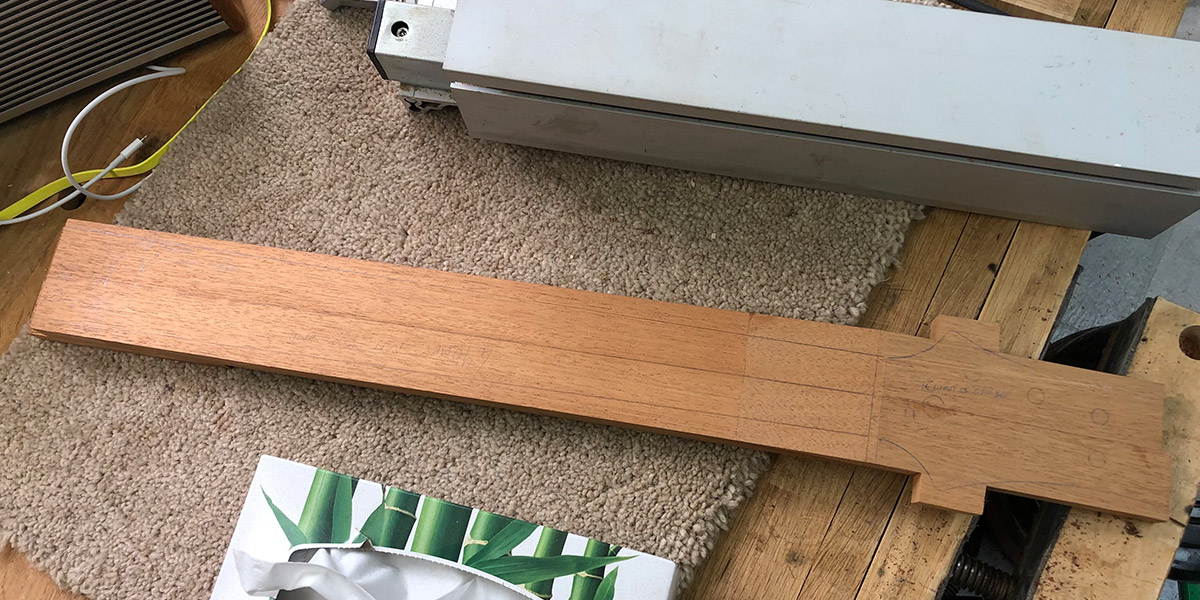
The plan was to install a new neck from my reclaimed Mahogany stash. This would be a 10 piece neck: I have to glue a whole puzzle of pieces of this Mahogany together, as each individual piece is way too small for the job. But it works, and it means I have enough of this precious wood for 4 necks; wood that would otherwise be scrap. In some of these necks I’m inserting two carbon beams for added strength as well as the trussrod.
The fretboard would be ‘Leopard’ Crelicam Ebony, a very distinctive spotted grain pattern of this gorgeous Ebony. I’ve taken to doing a 12th fret decoration using several sizes of Paua dots to create a star constellation effect which suits the pattern of the wood. Then a pair of Fishman Fluence pickups, to combine with the Ghost system. I chose the Fluence as they are renowned for their incredibly clean sound, so I though that would combine well with the 6 Piezo pickups. It would create more wiring than the average laptop inside, which was a bit disconcerting at first, but the lack of F holes would help hide it.
But, to my absolute amazement, the wiring was a cinch. Fishman, with the Fluence system, supply a pre-wired set of controls which all plug together and Graphtech do the same with the Ghost. The only challenge would be to get them to talk to each other and share a power supply, but it became clear that Graphtech had thought that through and supplied all the necessary interface leads. The net result was I fitted the whole rats nest in about 3 hours, The trickiest bit being getting to the location of some of the 7 pots and switches without extending the existing control aperture.
But it all went in and all worked first time. Now, I need to start playing it!

I am fascinated to report that the mahogany neck has transformed it in terms of enjoying playability and I’m trying to figure out why. While the first neck was a 24 fret, and the new one 22, they are both a 20th fret body join and the same scale, so that isn’t the issue. I think it had to be to do with the neck profile, which was quite a flattened D profile. I’ve got a lot more nuanced in the years since I originally made it and now the necks flow better… to my hands, anyway. It sounds great, though the alternative switched sounds on the Fishmans are too subtle to be very interesting, something I’d seen commented online. But they have a real bell like clarity and combine well with the Piezo. On its own the Piezo has soime clever modelling in the pre-amp by Fishman, so the acoustic sound is really pretty smart.